
Understanding spec vs PRD is essential for building reliable products. Many teams confuse these two concepts—and that’s where execution starts to break.If you’ve ever faced unclear requirements, rework, or inconsistent features, the issue might not be development—it might be documentation.
What is the difference between spec vs PRD?
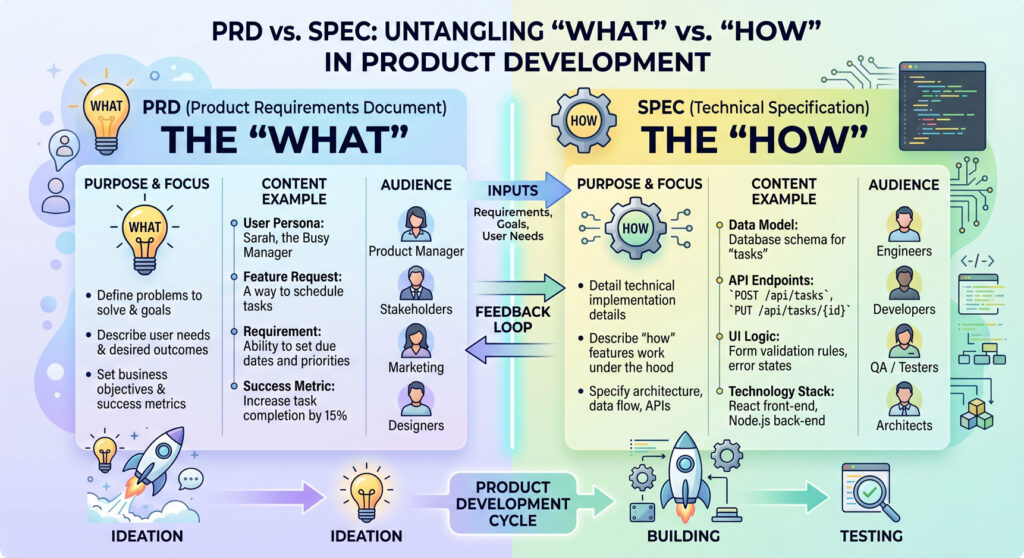
The core difference between them lies in purpose and detail.
- PRD (Product Requirements Document) → defines what and why
- Spec → defines how the system behaves
In short:
- PRD aligns vision
- Spec drives execution
What is a PRD in product development?
A PRD outlines the problem, goals, and requirements.
- Problem statement
- Business goals
- User needs
- High-level requirements
- Success metrics
It helps stakeholders align before design and development begin.
For deeper reading, see:
Atlassian PRD guide
What is a spec in Spec Driven Design?
A spec defines how the system behaves in detail.
- User flows
- UI states
- Business logic
- Edge cases
- Data structures
- Permissions
- Acceptance criteria
Unlike a PRD, a spec is executable – it guides engineering and QA directly.
Spec vs PRD: Practical comparison
| Aspect | PRD | Spec |
|---|---|---|
| Purpose | What and why | How it works |
| Detail | High-level | Detailed |
| Audience | Stakeholders | Engineers, QA |
| Timing | Early stage | Pre-development |
Why the spec vs PRD distinction matters
Confusing them leads to predictable issues:
- Missing implementation details
- Late design decisions
- QA gaps
- Inconsistent behavior
As a result, teams slow down and quality drops.
How spec and PRD work together
- PRD defines the problem
- Design explores solutions
- Spec defines behavior
- Development executes
- QA validates against the spec
They are not alternatives—they are complementary.
Example: spec vs PRD in practice
PRD:
Users should be able to assign roles and manage access.
Spec:
- Role definitions
- Permission matrix
- UI behavior
- Error states
- Edge cases
This difference directly impacts product quality.
Spec vs PRD in AI-driven development
In AI workflows, it becomes even more critical.
AI can interpret high-level inputs—but performs best with structured detail.
- PRD → context
- Spec → execution-ready instructions
Learn more about structured documentation:
Martin Fowler on documentation
Common mistakes teams make
- Merging spec and PRD into one vague document
- Skipping specs entirely
- Relying on engineers to fill gaps
- Ignoring edge cases
Final thoughts
If your team:
- debates behavior during development
- revisits decisions late
- fixes issues after release
You may not have a development problem – you may have a spec vs PRD problem.
Clarity upfront leads to speed and quality later.